
Health and Safety Legislation
The framework standard of reference is Law 31/1995 of 8 November, on Occupational Risk Prevention (LPRL). The LPRL expressly establishes the right of workers to effective occupational health and safety protection, which means that employers have a corresponding duty to protect their workers from occupational risks.
The ownness is on Exhibitors, and their appointed contractors and subcontractors, to familiarise themselves with the Royal Decree 31/1995.
To download a copy of this official document please click here.
Health and Safety Regulations
This section outlines health and safety guidelines for your stand at the show. As an Exhibitor, it is your legal responsibility to ensure your operations and attendance at the event do not compromise safety. Make sure you and your staff, including contractors, fully adhere to these guidelines. Failure to comply can result in legal consequences. If you are unsure about anything, contact our Customer Success team promptly.
Introduction to Risk
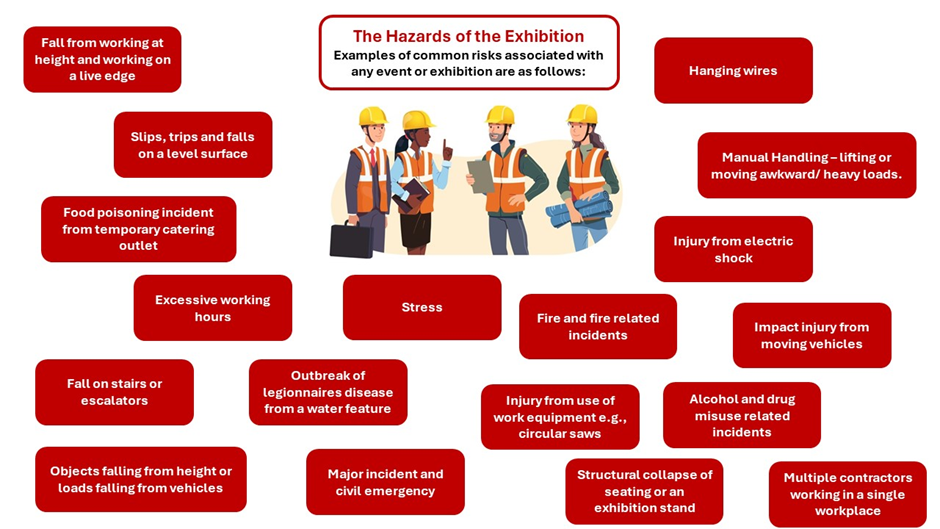
The exhibition halls are an ever-changing environment with constant construction and dismantling of exhibition stands and with different layouts and rules for each event. This means there are hazards specific to the show and industry such as large exhibits, moving vehicles, multiple persons working, overhead works, hanging cables, open floor traps, construction site environment (build/breakdown), emissions, dust, and other substances in the air. This is not an exhaustive list.
These are generic hazards for consideration for anyone who may enter the exhibition halls and does not cover any specific event. Anyone working on a specific event should review and discuss with persons who have experience of the event, request site of the organiser risk assessment and follow the risk assessment of their employer.
Who is at risk?
Everyone working in or passing through the exhibition is at risk to some extent.
Those whose work is in the exhibition are at risk due to their constant exposure.
Those who do not normally work in the halls will be at risk because the environment will be unfamiliar, and they will be less aware of the day-to-day hazards.
Who is most vulnerable?
Persons with little or no knowledge of the exhibition.
New and expectant mothers may be especially at risk and should not work within the exhibition without a specific Risk Assessment to cover their activities.
Young persons (aged 16 – 18) have a lower perception of risk in general and should be subject to a specific Risk Assessment to cover their activities.
Managing the risk
To stay safe, avoid risks whenever possible. Avoid using the halls as a transit r oute, especially during build and breakdown. If you do not need to be in the halls, stay out of them. If you must enter, be aware of hazards, follow safety signs, and never enter prohibited areas. Avoid obvious risks like overhead work. Always wear appropriate Personal Protective Equipment (PPE) such as high-vis jackets, suitable footwear, and protective hard hats where required. Remember, PPE should be a last resort - it is best to avoid risks altogether. Children under the age of 16 are not allowed in the halls during build, show opening, and breakdown. When the show is open, young persons under the age of 18 are not permitted inside the halls.
e-Guide
The aim of this guidance is to set standards which will safeguard the health and safety of any person working at or visiting an event or exhibition. The guide should be used to guide the organiser, the venue, contractors and exhibitors with regards to the minimum acceptable safety standards in any country whilst recognising that many countries may have higher standards which will take precedence. The guide is widely applicable to events but have been written specifically with exhibitions in mind. The guidelines cover the main areas of risk. Advice should be sought on areas not covered by these guidelines.
Our exhibitor manual and venue rules are also formed on the basis of this guide. Please refer to this prior to submitting standplans
To download a copy of the e-guide use this link.